You're exhausted, but you can't switch off. Your to-do list is short, yet your body is acting like the building's on fire. You snap at someone you love over nothing and then wonder what's wrong with you. If that sounds familiar, here's the reframe worth holding onto: nothing is wrong with you. You're not lazy or broken. Your body is just running a very old safety program a little too often.
That's the short version of what people mean by nervous system regulation, and the good news is that it's a skill you can practice. This guide keeps it simple: what regulation actually is, how to tell when yours has slipped, what's throwing it off, and the handful of things that genuinely help calm a dysregulated nervous system.
What nervous system regulation actually means
Most of what keeps you alive runs on autopilot. Your heartbeat, your breathing, your digestion: you're not choosing any of it. That autopilot is your autonomic nervous system, and the simplest way to picture it is as a gas pedal and a brake.
The gas pedal is your sympathetic nervous system. It runs the fight-or-flight response: heart up, breath shallow, muscles primed, attention locked on the threat. The brake is your parasympathetic nervous system, often called "rest and digest." It slows your heart, deepens your breath, and lets your body get back to quieter work.
A lot of that braking runs through one remarkable nerve. The vagus nerve carries roughly three-quarters of your parasympathetic fibers, wandering from your brainstem down to your heart and gut. When people talk about "calming the nervous system," this is mostly the pathway they're reaching for.
So what is regulation, exactly? It isn't living permanently in rest-and-digest. The gas pedal is supposed to fire for a real deadline or a near-miss in traffic. Regulation is flexibility: revving up when it counts, then easing back down when the moment passes. Therapists sometimes call that comfortable middle your "window of tolerance," which is a helpful mental map, not a measurement.
What a dysregulated nervous system feels like
A dysregulated nervous system is one that's lost some of that flexibility. The gas pedal sticks. You stay revved long after the trigger is gone, or you swing hard between wired and shut down.
It usually shows up in the body first. The American Psychological Association's stress surveys keep finding the same physical signals at the top of the list:
- Feeling nervous or anxious
- Fatigue and low energy
- Headaches
- Trouble focusing, or "brain fog"
- A short fuse and feeling easily overwhelmed
In fact, the APA reports that most adults say their stress is physical, not just mental. If you recognize yourself here, you're in very ordinary company. It doesn't mean something's broken; it means the system that's supposed to protect you has been on duty too long without a break.
What pushes your nervous system out of balance
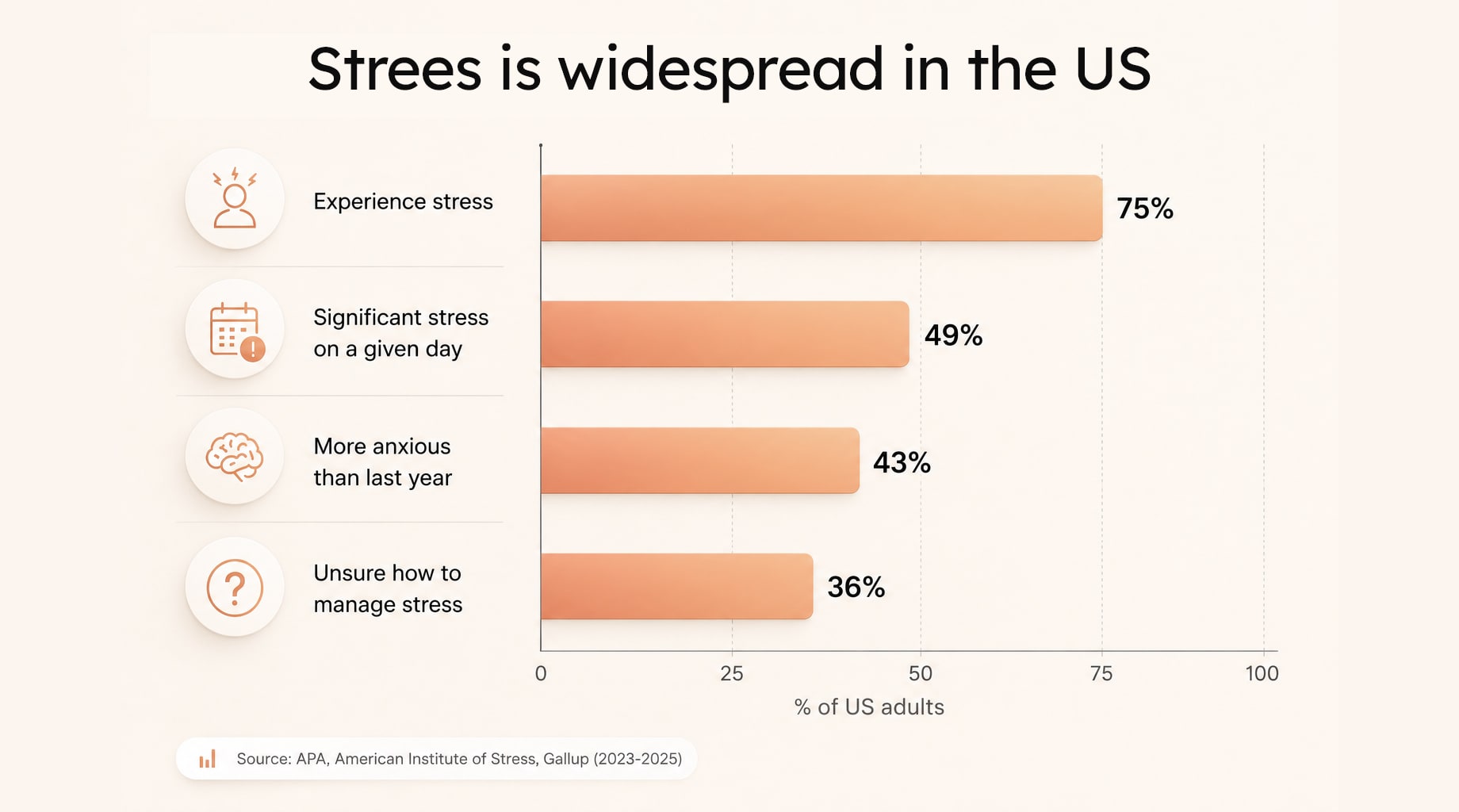
Mostly, modern life does. Stress in the US is close to a default setting. The American Institute of Stress puts the share of adults experiencing stress at around three-quarters, and Gallup finds that roughly half of Americans feel significant stress on any given day. The American Psychological Association pegs the average self-rating at about a five out of ten, and that steady, low-grade five is part of the problem.
A nervous system built for short bursts of danger ends up handling a hum of pressure that never quite lets up.
That matters because the wear adds up. The APA links chronic stress to a higher risk of things like heart disease, high blood pressure, digestive trouble, and a weaker immune response. And plenty of people feel stuck with it: in one of the association's surveys, more than a third said they weren't even sure how to start managing their stress.
The good news, and the point of the rest of this guide, is that you can do something, and it doesn't take a clinic or a credit card.
How to regulate your nervous system
If you take only one thing from this article, take this: your breath is the steering wheel. It's the one autopilot function you can grab manually, and slowing it down is the most reliable way to press the brake.
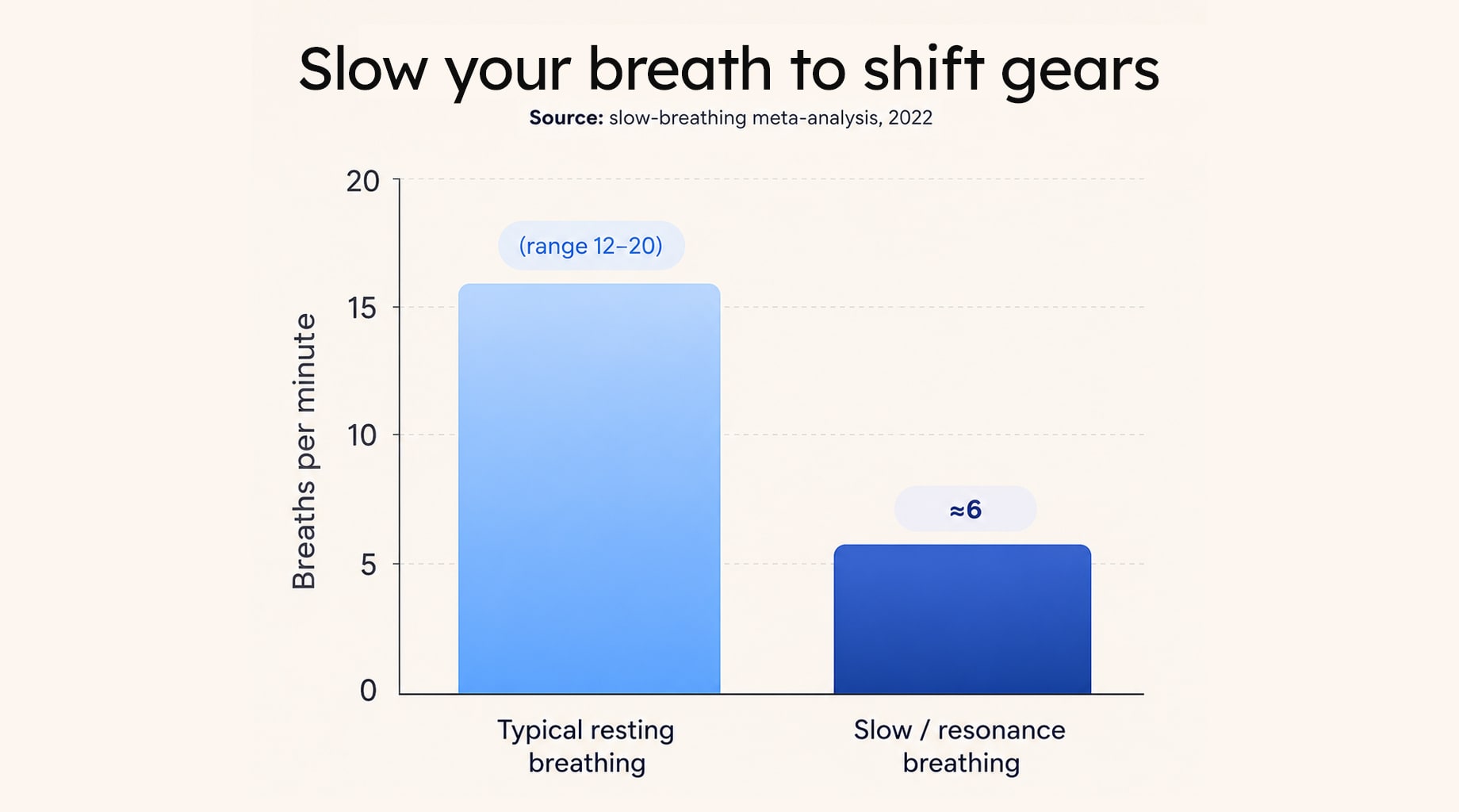
Slow your exhale. At rest, most adults breathe somewhere between 12 and 20 times a minute. A 2022 meta-analysis of slow-breathing studies found that easing down to around six slow breaths a minute, with a smooth inhale and a longer, unhurried exhale, measurably shifts you toward the parasympathetic side and lifts your heart-rate variability, a marker of a flexible, well-regulated system. Try breathing in for about four counts and out for about six, and let the exhale lead. A few minutes is enough to feel the difference.
A few more levers, all free:
- Move your body. A brisk walk, a few flights of stairs, a quick stretch. Movement burns off some of the fight-or-flight charge and signals that the danger has passed.
- Protect your sleep. Stress and sleep feed each other, and not in a good way. A nervous system that never gets proper rest stays touchy.
- Reach for other people. A real conversation, a hug, time with someone who feels safe. Connection tells your body, below the level of words, that you're not facing the threat alone.
Notice what's not on that list: nothing exotic, nothing to buy. You'll see ice baths, humming, and vagus-nerve gadgets all over the internet, and some people swear by them, but the honest position is that the evidence there is thin and mixed. Start with breath, movement, sleep, and connection, the things we have good reason to trust.
How long does it take?
Two answers, because there are two timescales.
In the moment, it's fast. A few minutes of slow breathing can take the edge off right now; you can feel the gas pedal ease while you're doing it. The catch is that the effect behaves a bit like a light switch: it comes on while you practice and dims again once you stop.
For a steadier baseline, it's slower. Early research suggests that practicing daily over a stretch of weeks may lift your resting calm over time, not just during the exercise. Think of it less like taking a pill and more like getting fitter. One walk doesn't make you an athlete; a habit slowly changes what "normal" feels like. So if a single breathing session doesn't transform your whole week, you're not doing it wrong. You're just early.
Is nervous system regulation overhyped?
Worth being honest here, because a lot of what you'll read online stretches well past the science. "Nervous system regulation" has become a wellness buzzword, and a few cautions are fair.
Much of the popular content leans on polyvagal theory, the ideas behind those "nervous system ladder" diagrams you've seen. It's an influential framework, but it's still debated among researchers, so it's wise to hold the tidy diagrams loosely. You'll also see confident promises to "lower your cortisol" by some exact percentage, or to "heal" anxiety with one trick. Be skeptical of precise numbers and miracle claims alike.
None of that makes the core idea fake. The autonomic nervous system is real, the brake and the gas pedal are real, and slowing your breath really does shift the balance. The trick is to take the basics seriously and the marketing with a grain of salt.
One more honest note: these tools are support, not treatment. If you're dealing with trauma, ongoing anxiety, or symptoms that won't lift, please loop in a qualified professional. Regulating your nervous system can sit alongside good care; it isn't a replacement for it.
The bottom line
If your body has been stuck in overdrive, that's not a character flaw. It's a nervous system doing its job a little too well. Start small and start today: a few minutes of slow breathing, one short walk, a real conversation, a decent night's sleep. None of it is dramatic, and that's the point. Regulation is built from ordinary moments, repeated. Your body already knows how to find calm; most of the work is just giving it the chance.
FAQ
What does it mean to regulate your nervous system?
It means helping your body shift smoothly between alert and calm instead of getting stuck in high gear. You're not switching off the stress response; you're restoring its flexibility.
How do you know if your nervous system is dysregulated?
The clues are usually physical and persistent: lingering tension, fatigue, headaches, trouble focusing, feeling wired but tired, or swinging between overdrive and shutdown. They're signals, not a diagnosis.
How fast can breathing calm your nervous system?
Quickly. A few minutes of slow breathing at around six breaths a minute can ease you in the moment. Building a steadier baseline, though, takes regular practice over weeks.
Can you regulate your nervous system naturally?
Yes, and the best-supported tools are free: slow breathing, regular movement, decent sleep, and real social connection do most of the work, no supplements or devices required.